
Top 7 Newsletter Platforms in 2026
A comparison of platforms for writers and content creators to help you choose the newsletter app with features that fit your needs.


Starting and running a newsletter in 2026 can feel like an overwhelming decision to make before you even write a single word because of the number of newsletter platforms claiming to be the best. The market is packed with “the best newsletter platforms.”
The best for growing your mailing list, the best for earning from your writing, the best for deliverability. And each of those claims may even be true, depending on who you are and what you want to do. Finding the best newsletter platform is all up to you, depending on what your niche is and what your goals are.
How we can help you find the best newsletter platform
You probably ended up on this page because you want to start a newsletter, or you are looking for a better home for the newsletter you already have. And because Fika is a place where we genuinely care about writers and want you to succeed, we want to help out.
Here is the thing, though: helping you is not as simple as pointing at one of these newsletter software and saying, "There. Start there."
The answer, like most things when it comes to writing, is more nuanced than that. Your newsletter niche, your audience, your goals—these are all different from the next writer's. A platform that works perfectly for a creator building a business around paid podcast subscriptions might be entirely wrong for someone just starting a newsletter about their local sports team.
What we can do is help you understand what you need as a newsletter creator so you can ask the right questions, and then you will be able to evaluate newsletter platforms on your own.
In this guide, we review the top newsletter platforms in 2026. We look at what each one does well, break down the costs of getting started, and walk you through how you can earn money with each option so you can make the decision yourself.
A List of the Best Newsletter Platforms
Below you will find a list of the top 7 platforms for newsletters. These tools are not all the same, in fact, some of them are quite different. But just as there are many different kinds of newsletters, there are many different kinds of writers, and they all have different reasons for creating newsletters. We hope that the list we created will help all writers find the newsletter tool that fits their needs the best.
1. Fika: 100% Free, SEO-friendly newsletter platform for international writers
Before we get into the full list of newsletter platforms, we need to take a moment to introduce ourselves as one of the newcomers to the newsletter space. Fika is a creator-first platform for newsletters and blogs, built in Europe, with an international audience in mind.
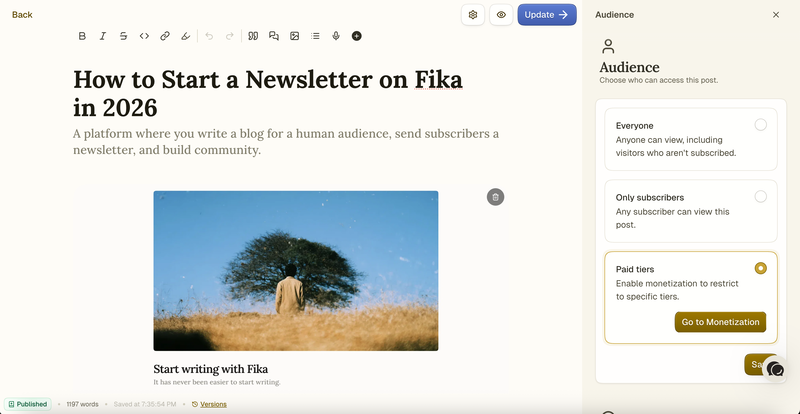
It is algorithm-free, distraction-free, and completely free to use! This newsletter platform is focused entirely on giving writers real ownership over their work and their readers.
Fika may be newer than the other platforms on this list, but it is growing fast. And like early YouTube or early Substack, the writers who show up early and publish consistently tend to benefit the most.
Features
Fika includes an easy-to-use editor designed to get out of your way so you can focus on writing. Built-in tools for proofreading check your writing and suggest edits you can accept or ignore, keeping your voice while fixing mistakes.
Before you publish, you can use auto-translation to reach readers in their preferred language, which is one of the few tools of its kind offered for free.
Unlike most newsletter platforms, Fika was built with SEO in mind, making it 100% SEO friendly. Posts are structured to rank in search engines, giving you a steady channel for organic growth that does not depend on platform algorithms. It also includes analytics, proofreading, automatic translation features so you can reach a wider audience, and tools for social sharing.
Everything you get on Fika:
Your personalized subdomain
Branding options (logo, header, or wordmark)
Custom header and footer snippets
Newsletter stats and analytics
Unlimited subscribers
Unlimited image storage
Unlimited translation requests
Unlimited proofreading requests
Unlimited voice notes
Contact import/export for audiences migrating from other platforms
Built-in newsletter with 100% email delivery
Cost to start
Fika is 100% free and only takes a small percentage of what you earn. There are no hidden fees, no premium tiers, and no gated features. When you create an account, you get full access to every tool.
How writers earn on Fika
Fika lets you give your readers a way to subscribe to your publication for a price you set. As your audience grows, Fika's platform fees decrease, so more of each subscription goes directly to you.
Fika uses Stripe Connect for payments, which has an added fee of approximately 2.9% + $0.30 per transaction.
Minimum subscription price: €5/month per reader
Platform fees:
0-99 paying subscribers: 10% platform fee
100-499 paying subscribers: 8% platform fee
500+ paying subscribers: 7% platform fee
This sliding fee structure represents one of the biggest differences between Fika and its competitors. Substack takes a flat rate of 10%, for example, no matter how big your audience is. Fika's fee drops lower as you grow. At 500+ paying subscribers, you keep 93% of your revenue before Stripe fees.
2. Substack: Newsletter platform with social media-like features
Substack has become one of the most well-known platforms for paid newsletters and was an important player in making the paid newsletter model as popular as it is today. It is easy to get started on Substack, handles email delivery and payments automatically, and comes with a built-in discovery network that can help new writers find early readers.
What sets Substack apart from most newsletter tools is its focus on social media-like dynamics. Notes is Substack's feed that looks and works just like Twitter and lets writers share short posts and interact with readers and other writers. The platform has also branched out into other mediums and now supports podcasts and video.
Features
Free and paid tiers for subscribers
Social feed (Notes) with algorithmic recommendations
Podcasts and video creation
Substack offers an app for mobile readers
Built-in payments and subscriber management
Cost to start
Substack is free to use and only takes a percentage once you start earning.
Platform fees:
10% of revenue from paid subscriptions
Stripe processing: approximately 2.9% + $0.30 per transaction
How writers earn on Substack
Writers can set their own subscription price tiers, which is typically between $5–$15 per month, and Substack takes 10%.
3. beehiiv: Newsletter platform with more monetization and growth tools
beehiiv is a platform designed with newsletter creators in mind, especially the ones who want to build a mailing list quickly and start making money in more ways than one. The platform stands out for its advanced analytics, a large collection of growth tools like referral programs, and even an ad network that lets you earn from sponsorships.
In some ways, beehiiv is more about running a business than building a community. It is not a blog or a place where people come to read. It is all about helping newsletter creators build lists, get to know their audience and make money in various ways.
Features
You can send out as many emails as you want on all of their plans.
Custom websites and templates, both for your website and your newsletter.
A/B testing, and all the other automations and segmentation features you'd expect
AI assistance for design and writing, because who doesn't want a bit of AI magic in their life.
An ad network that lets you earn from brand sponsorships
Boosts (you earn by recommending other newsletters to your readers)
Getting started on beehiiv
The Launch plan is free as long as you stay under 2,500 subscribers. This tier has everything you need to get up and running. Once you pass a certain point, you will need to upgrade to a paid plan.
Scale is $49/month for getting access to paid subscriptions, the ad network, and a few more advanced features.
Max is $109/month, which removes beehiiv branding, adds audio newsletters, and a bunch of other tools you can use to grow your list.
Enterprise includes custom pricing for big users above 100k+ subscribers
How writers get paid on beehiiv
Because of the platform fees you already pay, beehiiv won’t take a cut of your earnings from paid subs. You charge your readers directly, and all you lose is a few dollars on transaction fees.
You also have other ways to make money:
The Ad Network will match you with brand advertisers that want to reach your audience
Boosts: Getting paid for recommending other newsletters to your readers
Selling digital products like courses and ebooks to your subscribers
4. Ghost: More technical setup, more customization
Ghost is an open-source publishing platform that lets writers have complete control over what they write, their member list, and their bottom line.
The flip side is that you 'll have to do some technical setup. If you go for self-hosted Ghost, you're on your own when it comes to figuring out server setup. On the other hand, if you opt for a paid plan, their managed hosting takes care of all the behind-the-scenes work, but be prepared to pay a monthly fee.
Features
Zero platform fee on subscription revenue
A website that is completely customizable right down to the theme
Email newsletters and member management features are built in
Integrations with other tools and services
SEO-friendly
Markdown editor
Cost to Get Started
Ghost comes with two options:
Self-hosted (no cost): Download Ghost and host it on your own server. You just pay for hosting.
Paid plans:
Starter: $15 a month gets you up to 1,000 members, managed hosting, and automatic updates
Publisher: $29 a month adds paid memberships, premium themes, and more detailed analytics
Business: $199 a month for bigger teams and publications with bigger traffic.
How writers get paid on Ghost
You get to keep 100% of the money you earn from paid subscriptions, minus the Stripe fee for processing.
5. Kit: Best for selling digital products
Kit (formerly ConvertKit) is an email marketing platform built with content creators in mind. What sets Kit apart from other newsletter tools is its automation features. You can create a visual flow of emails, set up funnels and target different parts of your audience with emails tailor-made just for them.
If you've got a creator business that also has a newsletter built in (be it courses, digital downloads, or paid coaching), Kit is built with this kind of workflow in mind. It isn't as focused on building a community or publishing as it is on selling and email marketing.
The Features
A drag-and-drop visual automation builder to set up your email sequences and funnels
Landing pages & forms
Sell digital products straight from Kit
Tag your audience and segment for targeted messages
A newsletter feed and website.
How much it costs
The free plan is pretty generous with 10,000 subs, unlimited broadcasts, and you get one visual automation, basic segmentation, and you can sell digital products too.
Paid plans
Creator: $33/month for 1,000 subs. On top of the free plan, this gets you unlimited automations, more email sequences and third party integrations.
Creator Pro: $66/month includes advanced reporting, a referral program for your newsletter, and subscriber scoring.
How writers make money on Kit
Writers can charge for their newsletter subs directly on the free plan. Kit doesn't take a cut of the profits, just a 3.5% + $0.30 transaction fee per paid sub. You can also sell digital products across all tiers.
6. MailerLite: best value for creators on a budget
MailerLite is one of the most affordable email marketing tools out there. It is one of the easiest to use for more advanced workflows.
Writers and small businesses looking to make a splash without getting bogged down in a steep learning curve or blowing their budget will find MailerLite is a pretty good platform for them when it comes down to basic newsletter sending.
MailerLite is perfect for those on a tight budget who want easy-to-use newsletter tools.
Features
A drag-and-drop email editor
Automations and email sequences
Landing pages and sign-up forms
A website builder with blog support
Paid newsletter subscriptions
RSS campaigns for bloggers
Getting started on Mailerlite
MailerLite has a Free plan that lets you send newsletters to up to 500 subscribers and 12,000 emails per month.
Paid plans are pretty affordable too:
Growing Business: starts at $10 per month for 500 subs, and you get unlimited emails, templates, 3 users to help out, and 24/7 support.
Advanced: starts at $20 per month for 500 subs, and you get unlimited users, a custom HTML editor, pop-up forms, and live chat support
Enterprise: if you have more than 100k subs they have custom pricing
Making money on MailerLite
MailerLite makes it easy to sell digital products and get paid for your work. They do not take a cut of your revenue. You charge your readers directly and pay the standard Stripe processing fee.
7. Buttondown: Best minimalist newsletter platform
Buttondown isn't trying to be an all-in-one tool. It's a straightforward newsletter tool where there's no clutter or complicated options to navigate, just a clean and simple tool for sending out great emails. It supports Markdown, has a clean web archive for every newsletter, and generally stays out of the way.
If you find tools like beehiiv or Kit a bit overwhelming, Buttondown is a breath of fresh air. It is the antithesis of a bloated tool. Sure it does fewer things than its competitors, but what it does, it does very well. And when it comes to pricing Buttondown is as upfront and transparent as you could want.
Buttondown is the perfect fit for writers and developers who want a no-nonsense newsletter tool that goes well with their workflow.
What Buttondown offers
A Markdown-first editor that makes sense to anyone who's ever written a post.
Clean subscriber management with tags and segmentation so you can keep your list tidy.
Automations and drip campaigns so you can send the right emails to the right people.
RSS-to-email feeds so you can aggregate your latest posts and send them to your subscribers without having to lift a finger.
Cost to Get Started
Buttondown has a free plan that covers up to 100 subscribers and gives you access to all the basic newsletter tools you need.
Paid plans start at $9/month for up to 1,000 subscribers and then just scale from there. There are add-ons available for segmentation, surveys, and multi-newsletter management if you need them.
How writers can earn on Buttondown
Buttondown also integrates with Stripe for paid subscriptions and takes no cut at all of your earnings, just Stripe's standard processing fees as other platforms on this list. It also supports tip jars and pay-what-you-want models so you can get creative with how you make money with the help of your readers.
Choosing the right newsletter platform for your needs
When we started this guide, we said that choosing the right platform was more than just going with the biggest name. After taking a closer look at these seven newsletter platform options, what has become clear is that choosing the right fit is pretty straightforward as long as you know what tools you will need the platform to include.
If you are looking for a free platform that caters specifically to writers offering features like translation, SEO, and proofreading, then Fika is pretty much the go-to free option.
If you want a big and active community right now and social media-like features to help others find your newsletter, Substack could be for you.
If you're treating your newsletter like a business and growth and making money is your top priority, beehiiv is a pretty option for that.
If you want to keep full ownership and zero revenue share is a big deal to you over ease of setup, Ghost is probably your best bet.
And if your primary needs are email marketing automation and selling digital products, then Kit has the most developed system for that workflow.
The bottom line is the right newsletter platform is the one that matches up with the kind of writing business you want to build. However, the tools you choose can only ever be as good as the consistency and your voice as the writer using them.

Comments
No comments yet. Be the first to comment!