
Is Your Writing Monotonous? Sentence Length Could Be the Culprit
How varying the length of your sentences makes your writing a joy to read.


Have you ever read something that was correct and made sense, but still felt boring? The problem might not be your ideas, it could be your sentence length. When all your sentences are about the same length, your writing can feel flat and repetitive. Even if your grammar is perfect, it can be hard for to keep your reader interested.
Think of writing like music. Notes that are all the same length sound boring. But if you mix short, medium, and long notes, the music comes alive. The same is true for sentences.
Changing sentence length gives your writing rythm
The length of a sentence affects how your writing sounds and feels to your reader.
Short sentences are quick, clear. They can grab the reader’s attention.
Medium sentences explain ideas more fully. They hold your readers hand and lead them into your text.
Long sentences build tension, describe something in detail, or add emphasis to the point you are about to make.
If all your sentences are the same length, the writing becomes predictable and monotonous. Your reader’s brain wants variety, it likes surprises in rhythm and pacing.
A classic example from Gary Provost
Writer Gary Provost shows this perfectly in his book 100 Ways to Improve Your Writing.
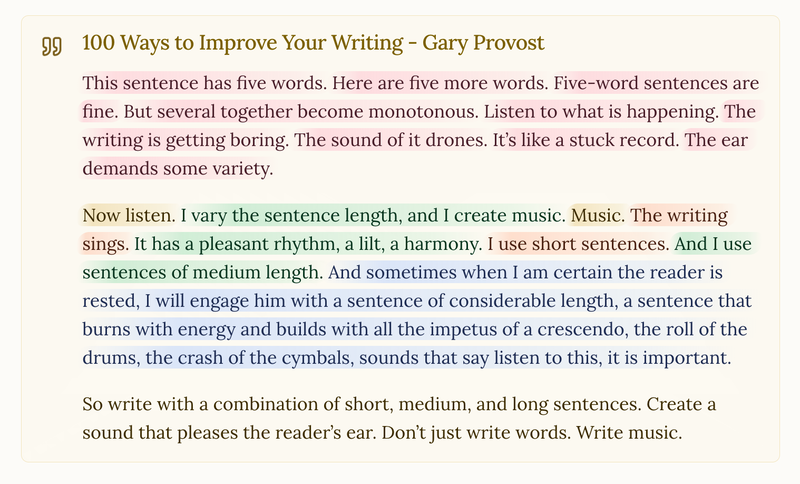
Let’s take a closer look at the first passage:
This sentence has five words. Here are five more words. Five-word sentences are fine. But several together become monotonous. Listen to what is happening. The writing is getting boring. The sound of it drones. It’s like a stuck record. The ear demands some variety.
Notice how each sentence is short and about the same length? Reading this, you can almost hear the rhythm drone. Even though the sentences are correct, they are repetitive.
Now see what happens when Provost changes sentence lengths in the next paragraph:
Now listen. I vary the sentence length, and I create music. Music. The writing sings. It has a pleasant rhythm, a lilt, a harmony. I use short sentences. And I use sentences of medium length. And sometimes when I am certain the reader is rested, I will engage him with a sentence of considerable length, a sentence that burns with energy and builds with all the impetus of a crescendo, the roll of the drums, the crash of the cymbals, sounds that say listen to this, it is important.
And again, Provost ends with this advice:
So write with a combination of short, medium, and long sentences. Create a sound that pleases the reader’s ear. Don’t just write words. Write music.
When sentence lengths vary, writing feels alive. It has rhythm, energy, and keeps the reader interested.
Examples of Monotony vs. Variety
To demonstrate, here’s an example of a few monotonous sentences.
The storm started in the afternoon. The wind grew stronger. The rain fell harder. The streets flooded.
All sentences are short and similar. The rhythm is the same, so the paragraph feels flat.
Let’s take a look at how we can make the text more interesting by varying the sentence length:
The storm started in the afternoon. As the wind grew stronger and the rain fell harder, the streets quickly flooded. The residents tried to reach higher ground. They feared the rising water. By nightfall, the town had learned how quickly nature could change what had once been familiar.
This version mixes short, medium, and long sentences. The rhythm changes, which makes the paragraph easier to read and more interesting.
How to Fix Sentence-Length Monoton
Here are some simple tips to fix monotony in your sentences, but remember that these are not rules set in stone and everything depends on what you are trying to achieve with your writing.
Mix short, medium, and long sentences: Short sentences grab attention. Long sentences explain or build tension.
Break up long sentences: If a sentence drags and doesn’t sound right, split it into two or three.
Combine short sentences carefully: If two short sentences repeat the same idea, join them into a medium-length sentence.
Read your writing out loud: If it sounds like a steady drumbeat with no variation, it is too monotonous.
Use sentence length for emphasis: Short sentences make something sound urgent. Long sentences slow the pace, build excitement, and add gravitas.
Use Fika’s Proofreader to Check Your Sentence Length
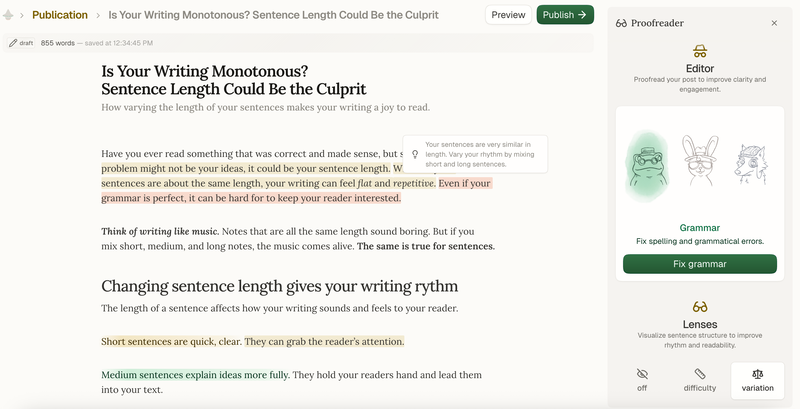
When you write with Fika, you can check your writing with our proofreader before publishing it. It can:
Analyze your text and visualize sentence structure, showing where sentences are too short, too long, or repetitive.
Give recommendations to fix grammar, tighten your writing, and improve the flow of your text.
Suggest ways to improve rhythm and clarity, making your prose more varied and easier to read.
Assess how difficult your writing is to read and how varied your sentence lengths are, so you can spot monotony before anyone else does.
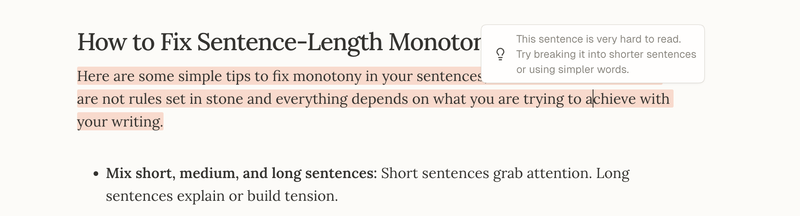
Sentence length might seem small, but it has a huge effect on how your writing feels. If every sentence is the same, the writing drags.
By mixing short, medium, and long sentences, you create writing that moves, flows, and even “sings.” Think of your sentences as music notes. Make them different lengths. Make them rhythmical. Make your writing enjoyable to read.
Create a free account and start writing on Fika, a new platform for writers of all kinds to publish their work!

Comments
No comments yet. Be the first to comment!